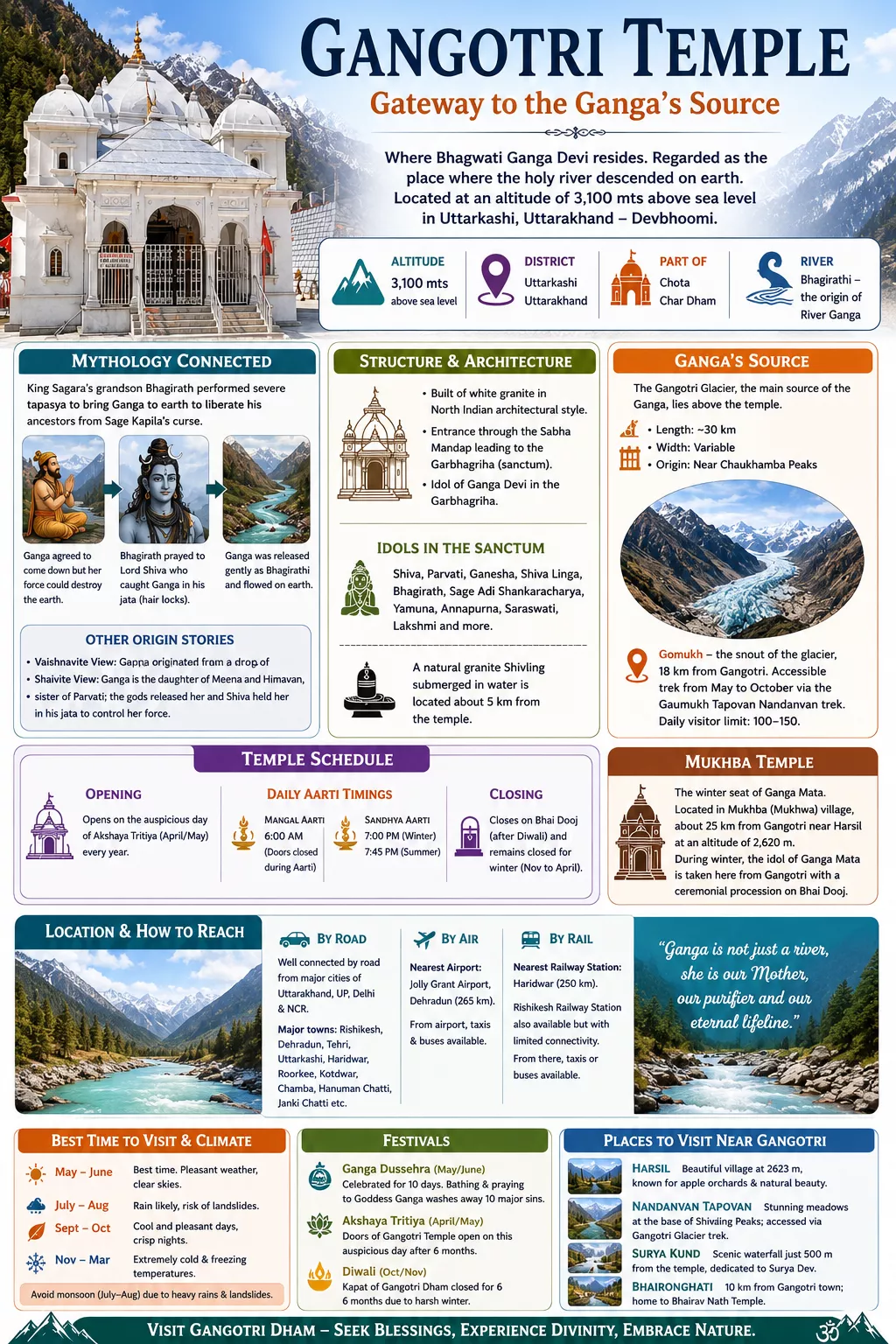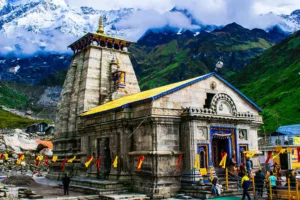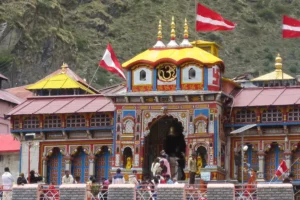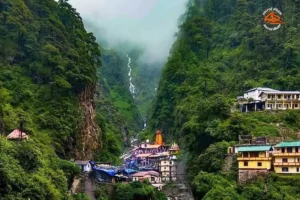


Gangotri Temple
Gangotri Dham is one of the four sacred shrines of the Char Dham Yatra in Uttarakhand. Dedicated to Goddess Ganga, this holy temple marks the place where the sacred river is believed to have descended from heaven to Earth. Located at an altitude of about 3,100 metres (10,200 feet) above sea level in the Uttarkashi district, Gangotri stands amidst the breathtaking Garhwal Himalayas, surrounded by snow-covered peaks, dense forests, and glaciers. The temple town is also home to several ancient ashrams, shrines, and temples that attract pilgrims seeking peace and spiritual blessings.
In Hindu tradition, the River Ganga is known by different names during her divine journey through the three worlds. She is called Mandakini in heaven, Ganga on Earth, and Bhagirathi in the Himalayas before meeting the Alaknanda at Devprayag. The name Tripathaga, meaning “the one who flows through the three worlds,” beautifully reflects this sacred journey. Because King Bhagirath’s penance brought the river to Earth, devotees also lovingly refer to the river as Bhagirathi.
Since ancient times, Hindus have worshipped the River Ganga as the holiest river in India. More than a river, devotees honour her as Goddess Ganga, believing her sacred waters purify the soul and wash away sins. For millions of pilgrims, a visit to Gangotri Temple is an act of faith that connects them with one of Hinduism’s most revered deities.
Mythology Connected with the Gangotri Temple
According to Hindu scriptures, King Bhagirath performed severe penance for many years to free the souls of his ancestors, who had been reduced to ashes because of Sage Kapila’s curse. Pleased by his unwavering devotion, Goddess Ganga agreed to descend from heaven and bless the Earth with her sacred waters.
The tremendous force of the descending river, however, threatened to destroy the Earth. To protect the world, King Bhagirath prayed to Lord Shiva, who received the mighty river in his matted locks. He gently released the water in small streams, allowing the holy river to flow peacefully across the Himalayas. This sacred stream later became known as the Bhagirathi River, which eventually joins the Alaknanda at Devprayag to form the River Ganga.
Other Origin Stories of Ganga
Several Hindu traditions describe the divine origin of Goddess Ganga, each highlighting her sacred nature and spiritual importance.
Vaishnav Tradition: According to one belief, Lord Brahma collected the sacred water that washed the feet of Lord Vishnu in his Kamandalu. From this divine water, Goddess Ganga emerged and later descended to Earth to bless humanity.
Shaivite Tradition: Another legend describes Ganga as the daughter of Himavan, the king of the Himalayas, and the sister of Goddess Parvati. When the gods requested her to descend to Earth, Lord Shiva received her in his matted hair to soften the force of her powerful flow before releasing her to the world.
Structure and Integral Architecture of Gangotri Temple
The Gangotri Temple reflects the elegance of traditional North Indian temple architecture. Built with white granite, the shrine stands against the backdrop of the majestic Himalayas and creates a peaceful atmosphere for worship. Its simple yet graceful design reflects the spiritual importance of the temple rather than architectural grandeur.
Pilgrims enter through the Sabha Mandap, which leads directly to the Garbha Griha, where the idol of Goddess Ganga receives daily worship. Devotees gather in the mandap to participate in pujas and aartis before offering prayers inside the sanctum.
The temple complex also houses idols of Lord Shiva, Goddess Parvati, Lord Ganesha, Sage Bhagirath, Adi Shankaracharya, Goddess Yamuna, Goddess Annapurna, Goddess Saraswati, and Goddess Lakshmi. Nearby, devotees can also visit smaller shrines dedicated to Lord Hanuman, Lord Shiva, and Bhagirathi Mata. A naturally formed Shivling, visible when the river level drops, lies near the temple and holds great religious significance.
Gangotri Temple: Gateway to the Source of the Ganga
The sacred Gangotri Glacier is widely recognised as the primary source of the Bhagirathi River, the main headstream of the Ganga. Stretching for nearly 30 kilometres, the glacier originates near the Chaukhamba massif and feeds the Bhagirathi, which later merges with the Alaknanda at Devprayag to form the River Ganga.
About 18 kilometres from Gangotri, Gaumukh marks the visible snout of the glacier and remains one of the most important pilgrimage and trekking destinations in Uttarakhand. Surrounded by magnificent peaks such as Shivling, Bhagirathi, and Meru, the trail attracts both pilgrims and adventure enthusiasts during the yatra season. To protect the fragile Himalayan ecosystem, forest authorities regulate the number of visitors permitted on the Gaumukh trek each day.
Schedule of the Temple: Seasonal and Daily
Every year, Gangotri Temple welcomes thousands of devotees as the Char Dham Yatra begins. According to Hindu tradition, the temple opens on the auspicious occasion of Akshaya Tritiya, marking the start of the pilgrimage season. Before the temple doors open, priests perform special rituals to honour Goddess Ganga at both the temple and the banks of the Bhagirathi River.
The temple remains open from April or May until October or November, depending on the Hindu calendar. During winter, heavy snowfall makes Gangotri inaccessible, so the temple stays closed for nearly six months.
Date of Gangotri Temple’s Closure: Bhai Dooj
The temple closes every year on Bhai Dooj, shortly after the Diwali festival. After the closing ceremony, priests carry the idol of Goddess Ganga in a traditional procession to Mukhba Village, where devotees continue worship throughout the winter months.
Daily Timings
The temple opens early each morning for Mangala Aarti and other daily rituals. General darshan usually begins after the morning पूजा and continues throughout the day. In the evening, devotees gather to witness the beautiful Sandhya Aarti, one of the most peaceful spiritual experiences at Gangotri Dham. During summer, the evening aarti generally takes place around 7:45 pm, while in winter it begins around 7:00 pm, depending on the temple schedule.
Further Details About Mukhba Temple: Winter Seat of Gangotri
Mukhba Village, also known as Mukhwa, serves as the winter home of Goddess Ganga. The village lies near Harsil in the Uttarkashi district at an altitude of around 2,620 metres. Every year, after the Gangotri Temple closes for winter, priests ceremonially shift the idol of Goddess Ganga to Mukhba Temple, where daily worship continues until the next pilgrimage season.
When the temple reopens on Akshaya Tritiya, devotees carry the idol back to Gangotri in a grand religious procession. This centuries-old tradition remains one of the most important rituals associated with the Gangotri Yatra.
Location and the Way to the Gangotri Dham
Gangotri Dham lies in the Uttarkashi district of Uttarakhand, about 250 km from Rishikesh, 100 km from Uttarkashi, and nearly 300 km from Dehradun. Pilgrims can reach the temple by road, rail, or air before completing the final stretch by road.
1.) By Road
Gangotri enjoys good road connectivity with Rishikesh, Haridwar, Dehradun, Uttarkashi, Chamba, and several other towns across Uttarakhand. Government buses, shared jeeps, and private taxis regularly operate during the pilgrimage season. The shrine is approximately 450 km from New Delhi by road.
2.) By Air
The nearest airport is Jolly Grant Airport, Dehradun, located about 265 km from Gangotri. From the airport, travellers can hire taxis or board buses to reach the temple via Uttarkashi.
3.) By Rail
Haridwar Railway Station serves as the nearest major railhead and offers excellent connectivity with major cities across India. Rishikesh Railway Station also provides rail access, although train services are more limited. From either station, pilgrims can continue their journey to Gangotri by bus or taxi.
Gangotri Climate: When to Go
The best time to visit Gangotri Dham is from May to June and again from September to October. During these months, the weather remains pleasant, the skies stay mostly clear, and road conditions generally remain favourable for pilgrimage and sightseeing.
The monsoon season, from July to August, brings frequent rainfall and increases the risk of landslides along the mountain roads. Pilgrims should check weather and travel updates before planning their journey during this period.
Winter begins in late October and continues until April. Heavy snowfall covers the region, temperatures often fall below freezing, and the temple remains closed throughout the season. During this period, devotees worship Goddess Ganga at Mukhba Temple.
Festivals Celebrated at Gangotri Dham
Several important festivals add to the spiritual atmosphere of Gangotri Dham and attract thousands of devotees every year.
Ganga Dussehra: This sacred festival celebrates the descent of Goddess Ganga to Earth. Devotees gather at Gangotri to take a holy dip in the Bhagirathi River and offer prayers, believing that sincere worship helps cleanse past sins.
Akshaya Tritiya: This auspicious occasion marks the opening of Gangotri Temple after its winter closure. Thousands of pilgrims visit the shrine to witness the ceremonial reopening and seek the blessings of Goddess Ganga.
Diwali: After the Diwali celebrations, the temple closes for the winter season. Priests then carry the idol of Goddess Ganga to Mukhba Temple, where worship continues until the following year.
Tourist Interest While Visiting the Gangotri Dham
Harsil: Surrounded by snow-covered mountains and dense forests, Harsil is one of the most beautiful villages in Uttarakhand. Located about 25 km from Gangotri, it is famous for its apple orchards, peaceful surroundings, and breathtaking Himalayan views.
Nandanvan and Tapovan: Adventure lovers and experienced trekkers often choose the Gaumukh, Nandanvan, and Tapovan trek for its spectacular mountain scenery. These high-altitude meadows offer magnificent views of peaks such as Shivling, Bhagirathi, and Meru, making the journey unforgettable.
Surya Kund: Located about 500 metres from Gangotri Temple, Surya Kund is a beautiful waterfall where devotees offer prayers to Surya Dev before or after visiting the temple. The powerful cascade and peaceful surroundings make it one of the most visited attractions near Gangotri.
Bhaironghati: About 10 km from Gangotri, Bhaironghati is famous for the ancient Bhairav Nath Temple and the deep gorge formed by the Bhagirathi River. The dense forests and dramatic landscape add to the spiritual charm of this sacred destination.