
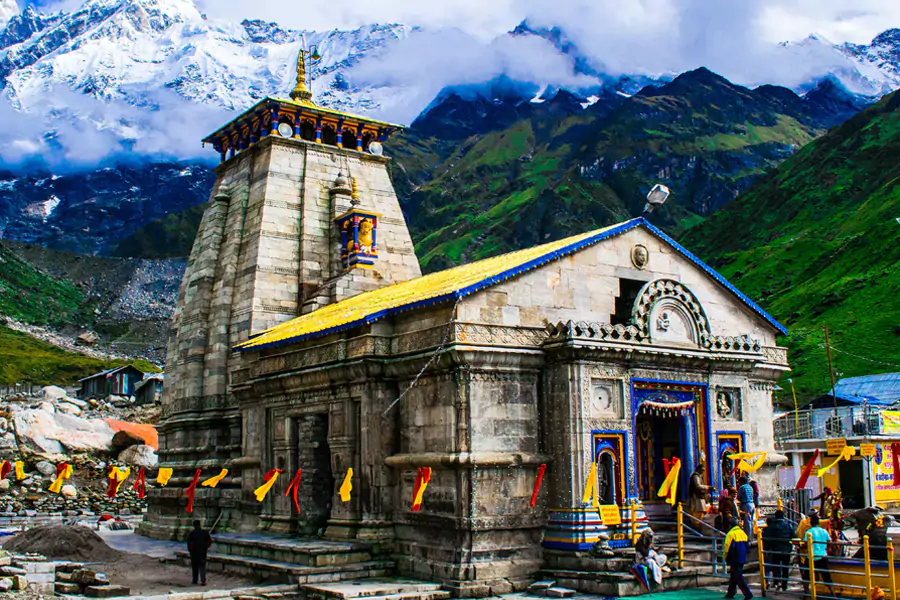
Kedarnath Temple
Located at an altitude of 3,584 metres above sea level on the banks of the Mandakini River, Kedarnath Temple attracts lakhs of devotees every year. The region was historically known as Kedar Khand. Kedarnath is one of the twelve sacred Jyotirlingas of Lord Shiva, situated in the Rudraprayag district of Uttarakhand. The temple is an important part of both the Char Dham Yatra and the Panch Kedar pilgrimage circuit. It is also among the most revered Shiva temples in the Garhwal Himalayas.
History of the Kedarnath Temple
The revered Kedarnath Temple is widely believed to have been restored by Jagadguru Adi Shankaracharya during the early 8th century CE. According to tradition, the original shrine was established by the Pandavas after the Mahabharata war. Adi Shankaracharya revived the temple and reaffirmed its importance as one of the twelve Jyotirlingas of Lord Shiva. His samadhi, located near the temple, is also a place of great spiritual significance for devotees.
Myths and Legends Related to Kedarnath Dham
Nara and Narayana’s Wish
According to Hindu tradition, Nara and Narayana, the twin incarnations of Lord Vishnu, performed deep penance at Badrikashram to seek the blessings of Lord Shiva. Pleased with their devotion, Lord Shiva appeared before them and asked them to choose a boon. They requested him to remain at Kedarnath as a Jyotirlinga so that devotees could receive his blessings and attain spiritual peace. Lord Shiva accepted their request, making Kedarnath one of the holiest pilgrimage destinations for Shiva devotees.
The Pandavas and Lord Shiva
After the Kurukshetra war, the Pandavas sought forgiveness from Lord Shiva for the sins committed during the battle. To avoid meeting them, Lord Shiva took the form of a bull and moved towards the Garhwal Himalayas. Bhima recognised the bull near Guptkashi, but before he could catch it, Lord Shiva disappeared into the earth. Different parts of his divine form appeared at five places: Kedarnath, Tungnath, Rudranath, Madhyamaheshwar, and Kalpeshwar. These sacred shrines later became known as the Panch Kedar, where the Pandavas are believed to have built temples in honour of Lord Shiva.
The Layout of the Kedarnath Temple and It’s Architecture
The magnificent Kedarnath Temple, dedicated to Lord Shiva, is believed to be more than a thousand years old. Its massive grey stone blocks continue to amaze visitors, raising questions about how such enormous stones were transported and assembled in the Himalayan region centuries ago.
Inside the assembly hall, devotees can see beautifully carved sculptures of Hindu deities and scenes from ancient mythology. A large statue of Nandi, the sacred bull of Lord Shiva, stands at the entrance to welcome pilgrims. At the heart of the temple lies the Garbha Griha, where the sacred stone representation of Lord Shiva is revered as the eternal form of Sadashiva.
Revival of Kedarnath Temple After the 2013 Flood Disaster
The 2013 floods caused widespread destruction across the Kedarnath valley, but the main temple remained structurally intact. Since then, extensive restoration and redevelopment work has improved the temple surroundings and pilgrim facilities. The project included wider walking paths, improved accommodation for priests and pilgrims, better bathing ghats, upgraded infrastructure, and enhanced helicopter facilities, while preserving the temple’s ancient heritage.
How to Reach Kedarnath Dham?
Kedarnath Dham is located in the Rudraprayag district of Uttarakhand and is well connected with major cities across India through road, rail, and air transport.
1.) By Rail
The nearest major railway station is Rishikesh Railway Station, located about 216 km from Gaurikund, the last motorable point for Kedarnath. Rishikesh has regular rail connectivity with several major cities across the country. From there, buses and taxis are easily available to reach Gaurikund.
2.) By Road
The road journey to Kedarnath ends at Gaurikund, from where pilgrims undertake an approximately 16 km trek to the temple. Gaurikund is well connected by motorable roads with major towns and cities of Uttarakhand and neighbouring states.
From ISBT Kashmiri Gate, Delhi, regular buses are available for Haridwar and Rishikesh. Taxis and local buses also operate from Dehradun, Haridwar, Rishikesh, Rudraprayag, Srinagar, Guptkashi, Sonprayag, and other important destinations in Uttarakhand.
3.) By Air
The nearest airport is Jolly Grant Airport, Dehradun, located about 239 km from Gaurikund. From the airport, travellers can hire a taxi or take a bus to Gaurikund before starting the trek to Kedarnath.
Helicopter Services to Kedarnath Temple
Pilgrims who prefer not to undertake the 16 km trek can choose helicopter services to reach Kedarnath. These services are available from authorised helipads at Guptkashi, Phata, Sersi, and other approved locations during the pilgrimage season.
Helicopter services provide a convenient option for senior citizens, families, and travellers with limited time. Since fares may vary every season, pilgrims are advised to check the latest prices and book only through authorised operators before planning their journey.
Schedule of the Kedarnath Dham: Daily and Seasonal
Every year, the opening ceremony of Kedarnath Dham draws thousands of devotees who gather to witness the sacred rituals. Pilgrims from across India and abroad consider the opening of the temple doors a highly auspicious occasion and eagerly wait for the beginning of the pilgrimage season.
Seasonal Timings: Kedarnath Temple remains closed during the winter months because of heavy snowfall and usually opens on the auspicious occasion of Akshaya Tritiya. Every year, the idol of Lord Kedarnath is brought from Omkareshwar Temple, Ukhimath, to the main shrine before the temple opens. The opening date is decided by the temple priests after consulting the Hindu Panchang. The temple closes for the winter on Bhai Dooj, following the morning rituals after Diwali.
Daily Timings: The Rawal, the chief priest of Kedarnath Temple, belongs to the Veerashaiva-Lingayat tradition of Karnataka. Devotees can participate in various pujas and rituals at the temple, while selected pujas can also be booked in advance through the temple authorities.
Aarti Times in Kedarnath: General darshan begins at 6:00 am. The temple remains closed for a short period between 3:00 pm and 5:00 pm for special rituals. Evening darshan continues until around 7:00 pm, after which the evening aarti is performed.
Temple timings may change because of weather conditions or instructions issued by the temple committee. Devotees who wish to perform Ghee Abhishek or other special rituals should reach the temple before the afternoon closure.
What to Know About Kedarnath Temple: Best Time to Visit?
Kedarnath is located at a high altitude, where the weather can change quickly throughout the year. During the monsoon season, heavy rainfall often causes landslides and road blockages, making travel difficult. For this reason, visiting Kedarnath Temple during the peak monsoon months is generally not recommended.
The months of May and June offer pleasant weather, with daytime temperatures reaching around 17°C, making them ideal for darshan and sightseeing. Another suitable time to visit is September and October, when the monsoon has ended and the surrounding Himalayan landscape becomes clear and beautiful.
Why the Shiva Lingam at Kedarnath has its unique shape?
The sacred Shivling at Kedarnath is unlike the smooth Shiva Lingams commonly seen in other temples. It has a naturally irregular, conical shape, which, according to Hindu tradition, represents the hump of Lord Shiva when he took the form of a bull to avoid the Pandavas. This unique form makes Kedarnath one of the most spiritually significant Shiva temples and adds to its religious importance.
The significance of the Samadhi of Adi Shankaracharya
Behind the temple stands the Samadhi of Jagadguru Adi Shankaracharya, where he is believed to have attained Mahasamadhi after restoring the shrine. Many pilgrims visit this sacred place along with the temple to pay tribute to the great philosopher who played a key role in reviving Hindu pilgrimage traditions across India.
The official puja booking process
Devotees can also book special pujas such as Mahabhishek, Rudrabhishek, Laghu Rudrabhishek, and Shiv Sahasranam Path through the Shri Badrinath-Kedarnath Temple Committee (BKTC). Since the number of pujas is limited during the yatra season, advance booking is recommended.
Travel tips for first-time pilgrims
Before beginning the journey, pilgrims should complete the mandatory Char Dham Yatra registration, carry valid identity proof, wear comfortable trekking shoes, keep warm clothing, and start the trek early in the morning. Carrying a raincoat, drinking water, basic medicines, and a small first-aid kit can make the journey safer and more comfortable.
Altitude sickness precautions
Since Kedarnath is located at a high altitude of 3,584 metres, some pilgrims may experience mild altitude sickness, including headache, dizziness, or shortness of breath. Walking at a comfortable pace, staying hydrated, and taking short breaks during the trek can help the body adjust to the altitude. Elderly travellers and those with existing medical conditions should consult a doctor before planning the pilgrimage.
The Places to Visit Around Kedarnath Dham
Nestled in the majestic Himalayas, Kedarnath Dham is a revered pilgrimage site and a gateway to many scenic and spiritually significant destinations. Visitors can explore ancient temples, peaceful lakes, and scenic landscapes while experiencing the rich heritage of the Garhwal region.
Gaurikund: This picturesque village is the starting point of the Kedarnath trek and is home to the ancient Gauri Temple, dedicated to Goddess Parvati. According to legend, Goddess Parvati performed penance here to win Lord Shiva as her husband. The natural hot water spring at Gaurikund is also considered sacred by pilgrims.
Triyuginarayan: This ancient temple is believed to be the sacred place where Lord Shiva and Goddess Parvati were married. Located near Sonprayag, it is famous for the eternal flame that, according to tradition, has been burning since their divine wedding.
Guptkashi: Guptkashi is well known for the Vishwanath Temple and the Ardhnarishwar Temple. According to Hindu belief, Lord Shiva stayed here in disguise before appearing at Kedarnath to bless the Pandavas.
Deoria Tal: Located near Ukhimath at an altitude of about 2,438 metres, Deoria Tal features a beautiful mountain lake surrounded by forests. On clear mornings, its calm waters reflect the snow-covered Himalayan peaks, making it a favourite destination for photographers and birdwatchers.
Chandrashila: Located at an altitude of around 4,000 metres, Chandrashila is one of the most popular trekking destinations in Uttarakhand. The summit offers breathtaking views of the Himalayan mountain ranges and attracts adventure lovers throughout the trekking season.
Agastyamuni: Situated on the banks of the Mandakini River, about 18 km from Rudraprayag, Agastyamuni is believed to be the meditation site of Sage Agastya. The ancient Agasteshwar Mahadev Temple is known for its religious importance and beautifully carved stone idols of Hindu deities.